
Table of Contents
What is Sacroiliac Pain?
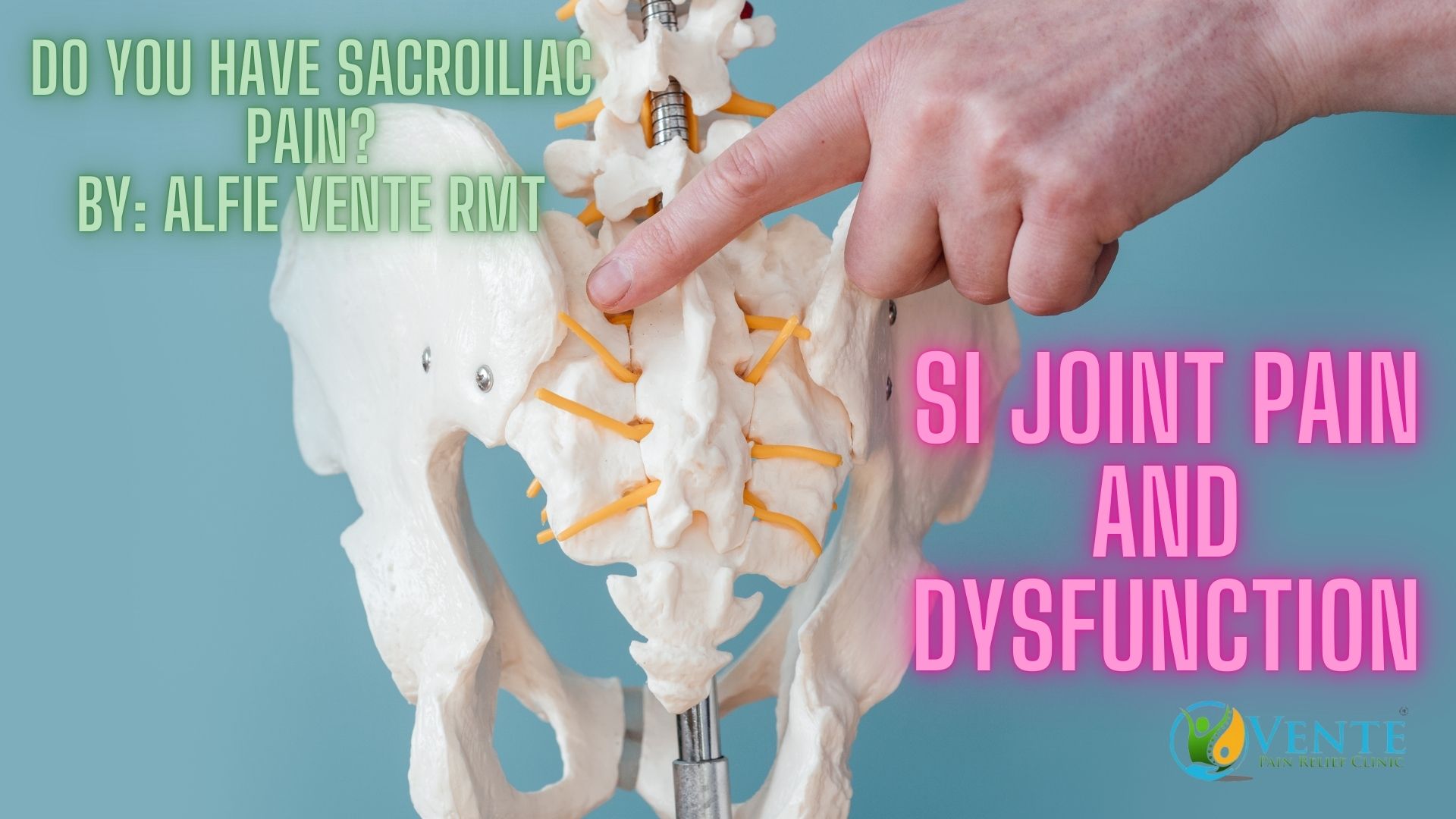
What is sacroiliac pain? Do you have lower back pain, hip/buttock pain or traveling pain from your buttock to just above the knee? You can suffer from a dysfunction/irritation of the Sacrolliac joint (SI joint). What exactly is the Sacroiliac? Many of you may have heard the term but are unsure what that body part actually is. The Sacro-Iliac is a joint located where your Ilium(this is the bone at each side of your lower mid-section where your thigh bones connect to) and the Sacrum(the thicker triangular portion of the ‘tailbone’) join.

Above is the area where sacroiliac pain is often felt. Many times an individual can describe the pain as being in the lower back. In fact dysfunction of the SI joint can often refer to the Lumbar spine(lower back vertebrae). It can also refer to the hip/buttock area and down the back of the thigh just above the knee.
At times, it can be difficult to assess where sacroiliac pain and dysfunction are coming from. The hip joint, lumbar spine, and SI joint can refer pain to each other. In most cases proper interviewing by the therapist can help determine the correct direction of treatment.
How Does the SI Joint Get Injured?
The SI joint can be injured in a number of ways causing sacroiliac pain and dysfunction. Below is a short list of possibilities:
- Any quick or unexpected rotational movements of the trunk
- Bending over and picking something up off the floor improperly
- Stepping off a step or sidewalk unexpectedly and “jarring”the joint
- Improperly doing exercises such as squats or lunges(there are other exercises that can cause dysfunction of the SI)
- Overdoing it on exercises such as the squat or lunges
- Sitting for prolonged periods such as at your work desk, or driving for long periods
- Bad posture
- Sleeping in an improper position
- Falling and landing on you buttocks
- Imbalance of the muscles of the thighs, where one muscle or muscle group is becoming too strong and “pulling” the body one direction
As you can see there are many ways that the SI joint can become injured. Often times the individual can also hint at a number of things:
- They can feel sore and stiff in the lower back once you wake up from sleep
- They feel that they can be leaning to one side when standing
- They feel that their body seems out of balance when walking or running
- It can be difficult to bend the knee to the chest
- Climbing stairs can cause pain and soreness in the SI joint
- Buttocks can be sore
- Sitting becomes uncomfortable and soreness is felt in the lower back
There can be different levels of sacroiliac pain and dysfunction. There are severe cases of SI joint dysfunction whereby it can effect bowel and bladder function. It can actually look like the person can have a urinary tract infection. This of course is extreme. For the most part SI joint pain and dysfunction is treatable and usually correctable.
How do I as a Massage Therapist treat SI joint pain and dysfunction?
One of the keys to correcting this issue is to figure out the mechanism of injury. In other words; how did the person hurt themselves? Was it from trauma? For example a fall where the individual landed on their buttock. Is it from an everyday, occupational or recreational activity causing the issue? For example sitting or driving.
If the mechanism comes from daily activities, it can usually be treated relatively easily. This is especially true if it is recent. It is easier because the muscles haven’t had time to adapt to a shorter or longer pathological length. The longer the time frame, the harder it is to restore the muscle to its “normal” or proper length.
If the injury resulted from trauma of years past, it can take a little longer to correct. Similarly, if it stems from a chronic activity, the individual has been doing this for over 6 months. It can also require more time. It can be correctable so as long as the person is diligent about therapy and home care.
I will observe you as a Massage Therapist from the time you are called. I will watch as you get up off your seat. I will then observe as you walk towards me and into the treatment room. This allows me to assess how you walk. Do you look balanced? Are you limping? Etc…
I will examine your posture. I can check the strength and flexibility (length) of your muscles. These factors can affect the SI joint. The SI joint is part of the area we call the Pelvis. Below is a picture of a pelvis if you were looking at someone’s front.
SI joint/pelvic issues can be caused by chronic muscle imbalances for most of the time. This is what I commonly see in my treatment room.
Because of the chronic imbalances, what I would want to accomplish is to bring balance back to the musculature. If your pelvis is incorrectly “sitting”, the muscles that attach to the pelvis can spasm. This can cause pain, discomfort, and dysfunction in the SI joint. The effects can also extend down the thigh, up the back, into the buttocks, and sometimes into the groin.
Some of the muscles that need to be treated include your lower back. Other important muscles are the Hamstrings (back of thigh) and Quadriceps (front of thigh). Additionally, the Gluteals (buttocks) and any other muscle(s) that attach to the Pelvis should be considered.
What I have found is that once the Pelvis is balanced, the muscles are relaxed. When this happens, the individual’s pain and discomfort “magically” disappear.
How Long Will it Take Before I Notice a Difference?
If the focus is on relaxing the muscles and balancing the pelvis, significant improvements often occur during the first treatment. After treatment, patients will comment about how relaxed their muscles are. They note how much more motion they have. They often mention how much their pain has decreased.
If it is of a trauma and scar tissue is involved, it can take a little longer. Keep in mind that your occupation and habits can also affect the treatment. If you are compliant with home care and massage treatments, you can return back to normal living, pain and dysfunction-free.
More Resources:
Watch our video on 3 local muscles that can cause lower back pain. Our Instagram has short, quick educational videos, visit now!

