Table of Contents
Introduction
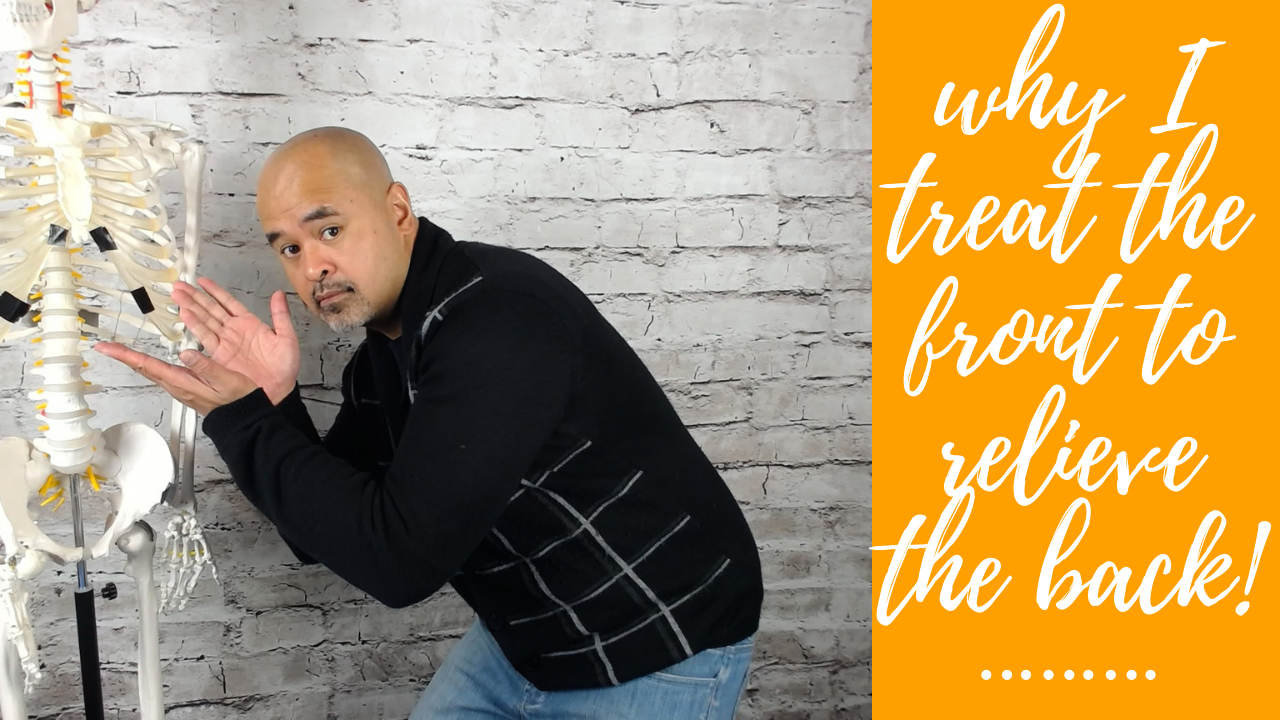
Fascia treatment for back and neck. Chronic issues of the back and neck can actually stem from tightness located on the front side of our bodies. This can be both the fascia and the muscles. Watch the video to find out more!
Over my many years as a Massage Therapist, I have made a key observation. Often, patients’ symptoms of the back and neck are actually more symptomatic of tight muscles and fascia at the front.
Posture plays a big role in this type of presentation. A typical scenario is of a patient that has an office job. They sit for prolonged periods. They will be sitting slouched, shoulders forward and rounded. They will also have a head forward position.
The sitting posture also shortens and tightens the fascia of the abdominal muscles and hip flexors.
Initially the person will start noticing neck and lower back pain. This can be from the local muscles becoming tight and overworked.
Fascia treatment for back and neck should actually be re-worded. It should actually be fascial treatments for the front to treat the back and neck.
Allow me to explain. Initially the local muscles of the neck and back can become tight. This can cause symptoms of pain and discomfort. However, over time, the muscles and fascia can tighten in and around the chest and front of the shoulders. The front of the neck, abdominals, hip flexors, and upper thighs can also become tight.
When the muscles and fascia become tight over a prolonged period, it affects the body’s biomechanics. This tightness places the shoulders, neck, lower back, and hips in less than optimal positions.
In a sense the shoulders, neck and abdominals, rib cage are drawn towards the center due to the amount of tightness.
Fascia treatment for back and neck along with the frontal aspect of the patient will be necessary. In fact most the primary goal of treatment becomes to correct the posture. It becomes less about the local muscles. It focuses more on the tissues causing the person to be in a terrible biomechanical position.
This doesn’t mean that we ignore the local muscles. It just means there can be less focus because there are structures that are more the priority.
Fascia treatment for back and neck
How does fascia treatment for back and neck look? The focus will be more on the front side. This means that from 15 minutes to 45 minutes will be required to release the front side.
The muscular structures that can be looked at include the Rotator Cuff, Deltoids, Pectorals, Abdominal muscles and Hip Flexors. The fascia of the anterior neck, Pectorals, rib cage, abdominals and Hip Flexors can also be zoned in.
The treatments can be aggressive. Patience and precision are important. This treatment can be super uncomfortable but at the end the patient will generally feel looser. A lot looser.
There will usually be an impact on the muscles of the neck, mid-back and lower back. This impact can be a significant decrease in muscle tightness. It is generally more significant relative to if we were just focusing on the local muscles.
It can also translate to better access into those stubborn muscles of the back and neck. Once the front is corrected it can also provide easier access to exercise motions that can correct the patient’s posture.
Fascia treatment for back and neck can benefit you. If you have chronic neck and back pain, contact us and we can discuss your case.

More resources:
Still unsure about if we are a good fit? Try our New Patient Assessment Survey. It can give you a clearer picture. This technique from our Pain Relief Fitness site, vprc.ca can help with lower back pain.
