
Table of Contents
Deep Tissue Massage for Tight Calves
Deep tissue massage for tight calves. A common complaint amongst athletes and non-athletes is calf tightness. This tightness can be exhibited when feeling the calf muscle. Alternatively, it can just feel tight without noticing any “hardness” of the calf.
This tightness can be felt when walking, standing or just constantly throughout the day and maybe worse at night.
How does this happen?
Generally, I will discuss superficial and deep layers of the lower leg muscles. I will also address contributing factors such as fascial restrictions that can cause this condition.
The superficial layer consists of two muscles; the Soleus and the one overlying this muscle the Gastrocnemius. Both of these muscles attach to the Achilles tendon, which attaches to your heel bone(Calcaneus).
The Gastrocnemius(Gastrocs, for short) are very powerful muscles. They are mostly used in explosive type of movements such as jumping or sprinting. It is a common muscle to become tight in individuals who exercise. This is particularly true for runners who lack a stretching program.
The Soleus is the deeper of the two and can become tight also from lack of stretching, standing or sitting too long. Many individuals have prolonged jobs requiring constant standing, sitting, or “moving around.” Jobs such as waitressing can result in the displeasure of calf tightness.
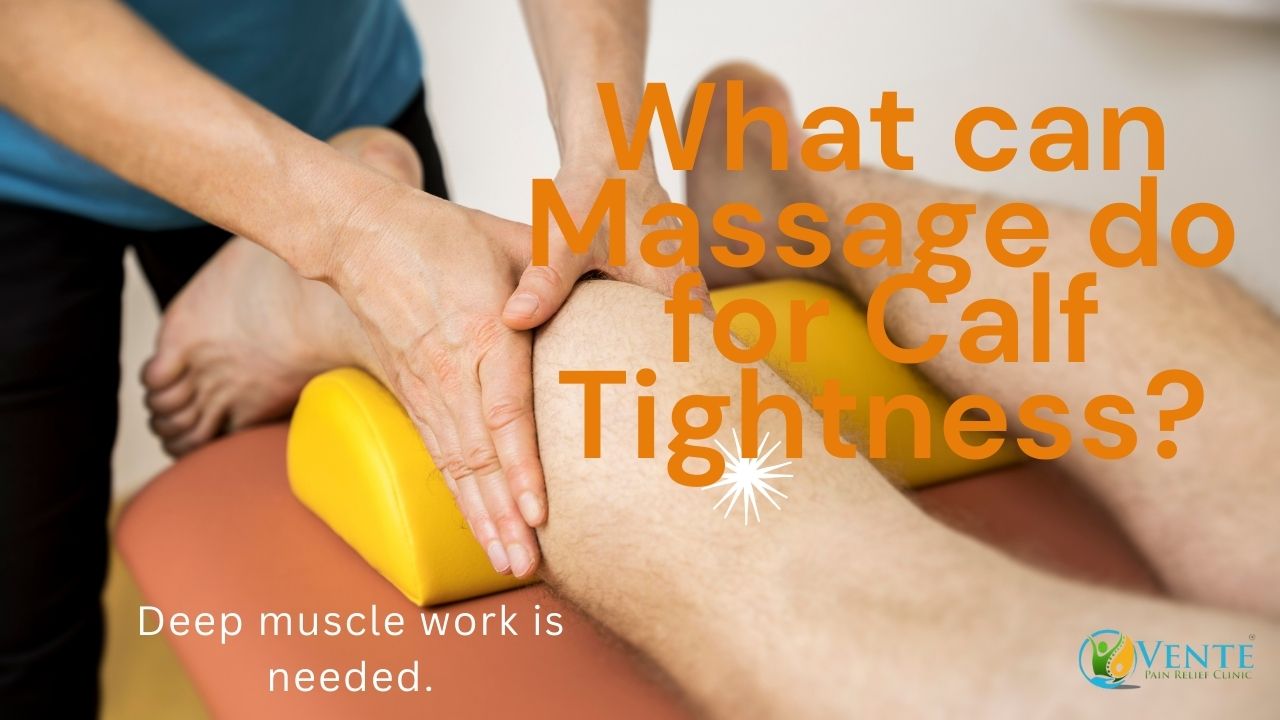
Deep tissue massage for tight calves is needed in this situation because the Soleus and Gastrocs are thick muscles. Also, deep tissue can access the deeper Soleus muscle.
Initially one of the home care prescriptions is to ask the patient to stretch these muscles out. Usually for 30 slow seconds, twice or thrice on both legs. Below is a picture to help you stretch your Soleus and Gastroc muscles.

Click on for instructions from “Top End Sports Medicine”
Often though, what will happen is that the individual can have trouble feeling any stretch when performing stretching. They can even get a very good range of motion but still feel that the calf is tight. This is when deep tissue massage for tight calves is necessary.
This usually indicates to me that the deeper muscles in the calf area can be tight. These muscles start at the top or middle of your leg. They extend from the sides, front, and back. They cross the ankle and reach into the foot.
Most of these muscles actually help to form the “inside” arch of your foot. These muscles move the ankle. They may also have a strong stabilizing influence on your arch (there is actually more than one arch).

You plant the balls of your toes to lift your heel whenever you walk or run. These muscles actually “pull” up on the arch. They stabilize the foot.
If for some reason there is too much motion in the joints that form the arch, these muscles often become tired. They get overworked trying to stabilize an area that is moving “too much”.
Individuals with flat feet tend to have feet that are more mobile. Often, these are the individuals that may show calf tightness without the calf actually being felt to be tight. This is because the pathological muscles are the ones deep in the calf. These are the ones that I mentioned before to be overworked from stabilizing an excessively mobile foot.
Here is a short test for you to see if you may have flat feet. This requires a partner. These are the instructions:
1. Stand bare footed on a hard flat surface.
2. Stand relaxed.
3. Have your partner try to place their index and middle fingers into your instep(under your arch).
You either have a normal arch or a very high arch. This occurs if you are able to place the fingers in with minimal issues. If you are unable to, then it shows that you may have “flat feet”.

Of course, this is one test. You need to get other more technical ones done to confirm. However, this could give you an idea of the type of arch you have. The flatness of your arch may be a predisposing factor to your calf tightness or contributing to the tightness. You may also present with sore feet along with calf tightness.
Another soft tissue reason that can cause calf tightness are fascial restrictions. These restrictions require aggressive work on the fascia. Deep tissue massage for tight calves can also be utilized. The fascia is the tissue that surrounds organs, muscles, bones and other structures. If you have ever cut open a chicken breast, you may have seen a white film that parts so you can access the “meat”. This is fascia.
Fascia gives muscles form and helps separate and differentiate muscles. What can happen some times is that the fascia can become very restricted. Fascia should be able to move fluidly like when skin is tugged, prodded or pulled.
When this tissue becomes restricted it can cause pain(via “latching on” to pain sensitive structures), discomfort and tightness. Restrictions can happen after a trauma, bad posture, emotional disturbances, nutritional deficiencies and post surgery scarring.
Fascial restrictions can be treated. Once the fascia is released, the patient feels fewer symptoms. They can actually feel stretches that were once hard to achieve. Once the fascia is released there is increased circulation in the area and muscles becomes relaxed.
Summary of Potential Causes of Calf Tightness
- prolonged sitting, standing or continuous activity with minimal stretching
- flat feet generally have more mobile joints and therefore the muscles that stabilize the arch and the foot must work harder
- fascial restrictions
These are the most common ways that a person may exhibit calf tightness. One must remember that there are also non-local reasons for calf tightness that should also be ruled out. For example. Issues with nerves at the lower back, buttock and potentially the knee and ankle can also cause calf tightness. That is why it is always a good idea to have your issue double checked by a rehab professional.
What can Deep Tissue Massage for tight calves do?
- decrease muscle tightness
- improve circulation
- stretch the tight muscles
- mobilize tissues such as the fascia
- relax other tissues that can contribute to the individuals condition
Hopefully, this blog has been helpful in teaching you about the possible reasons for calf tightness. If you want more freedom and decreased restriction, try massage therapy. You should notice a difference after treatment. If you have a question please contact us.
Deep tissue massage for tight calves can be very painful but it has many benefits. It is aggressive but it can do wonders for mobility and pain.

More resources:
The Piriformis is a muscle that when it has trigger points can refer into the calf. Learn more here.
